On May 18, 1980, at 8:32 a.m. Pacific Time, Mount St. Helens erupted, ejecting 540 million tons of ash, destroying approximately 230 square miles of forest, and completely sterilizing the landscape directly in the path of the devastation. Today, Evergreen faculty and ecosystem ecologist Dr. Dylan Fischer is bringing Evergreen students to the slopes of Mount St. Helens to contribute to over 45 years of continuous research and data collection focused on the mountain’s recovery.
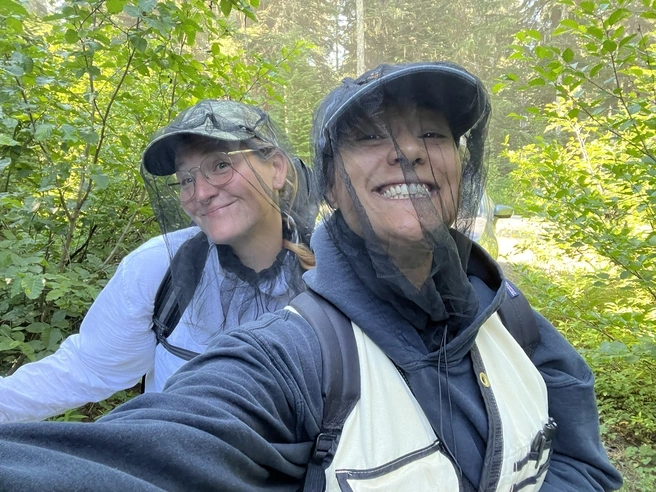
During this past summer, Madelyn DelaCruz ’26 and Gates Marshall ’26 were able to join Dr. Fischer in his research, thanks to Evergreen donors. Both Gates and Madelyn received the Summer Undergraduate Research Fellowships (SURF), funding that gives students the chance to get into the field alongside faculty to take part in impactful career-expanding research.
Madelyn looked at vegetation regrowth on the Mount St. Helens pumice plains, a six-mile-wide ecological "blank slate" completely wiped clean of life during the eruption. Her research will advance the understanding of how plants regenerate in catastrophic disturbance zones. In the old-growth forests outside the blast zone, Gates investigated the impact of continuous debris burial on plant communities. Gates' findings reveal that these plant communities are surprisingly resilient to burial, thanks largely to clonal reproduction strategies, and may have pre-adapted to recover from catastrophic events like volcanic ash fall.
Madelyn and Gates’ research is now part of one of the longest-running and most comprehensive volcanic monitoring studies in history. The lessons learned from this long-running research are shaping our comprehension of environmental regeneration on Mount St. Helens and helping to inform worldwide understanding of ecosystem recovery. Both Gates and Madelyn are continuing on to funded graduate research positions upon graduation.